
Asiad 20: Vietnam's Women's Kata Team Defends Gold 5-0 — And the Data Behind the Medal
**Core answer:** Đội kata nữ Việt Nam gồm Nguyễn Thị Ngọc Trâm, Bùi Ngọc Nhi và Hoàng Thị Thu Uyên bảo vệ thành công HCV Asiad 20 tại Toyohashi, Nhật Bản, thắng đội Iran 5-0 ở chung kết. Đây được ghi nhận là HCV đầu tiên của đoàn thể thao Việt Nam tại kỳ đại hội này. **Key facts:** - Tỷ số 5-0 tại chung kết kata đồng đội nữ: hội đồng giám khảo đồng thuận không phân biệt. - Bùi Ngọc Nhi nhận tỷ số 0-5 ở kata cá nhân trước võ sĩ chủ nhà Nhật Bản, sau đó giành HCĐ. - Nguyễn Thị Diệu Ly giành HCĐ hạng cân 68kg nội dung kumite. - Tổng thành tích karate Việt Nam tại Asiad 20: 1 HCV và 2 HCĐ. - Tiền thưởng được nêu cho bộ ba kata nữ: khoảng 1,2 tỷ đồng (đang chờ xác minh cấu trúc chia thưởng). **Source attribution:** Bản tin tổng hợp kết quả karate Việt Nam tại Asiad 20, công bố trong chu kỳ đại hội tổ chức tại Nhật Bản; dữ liệu chưa đối chiếu được với sổ kết quả chính thức của WKF và OCA. | Cross-checked: VuaBong.vn **Related Q&A:** - Q: Kata đồng đội khác kata cá nhân ở điểm nào? A: Kata đồng đội ba người lấy tiêu chí đồng bộ làm trục chấm điểm chính, trong khi kata cá nhân tập trung vào độ khó và cường độ của bài quyền. - Q: Tỷ số 5-0 trong kata có phải là điểm số kỹ thuật không? A: Không, đó là kết quả thể hiện sự đồng thuận của hội đồng giám khảo về mức độ hoàn thiện của bài thi, có thể đã được bản tin gốc đơn giản hóa. - Q: Vì sao HCV Asiad karate có giá trị thị trường thấp hơn HCV ở môn còn trong chương trình Olympic? A: Karate đã bị loại khỏi chương trình Paris 2024 sau Tokyo 2020, làm giảm độ phủ truyền thông và khả năng thu hút tầng tài trợ doanh nghiệp.
Toyohashi Gymnasium, Aichi Prefecture, Japan. The scoreboard showed a tidy figure: 5-0. No technical points to dissect, no dissenting judge. Nguyễn Thị Ngọc Trâm, Bùi Ngọc Nhi and Hoàng Thị Thu Uyên stood in the centre of the tatami, three shadows falling at the same angle, breath not yet settled. Across the floor, Iran's kata team bowed. The stands applauded, but the sound was not loud — kata is a discipline where the applause usually arrives later than the breathing.
A few hours later, on another tatami in the same venue, Bùi Ngọc Nhi walked into the individual kata event and came away with a 0-5 scoreline against a host-nation Japanese athlete. Same day, same ruleset, same judging standard — two results at opposite ends of the scale. That is where any reading of Vietnam's karate campaign at Asiad 20 has to begin.
Before going further, a word on method. Every result datum in this piece — athlete names, scorelines, medal count, prize money — comes from a single aggregated brief whose original outlet I have not been able to verify. Until cross-checked against the official results ledgers of the World Karate Federation (WKF) and the Olympic Council of Asia (OCA), I classify them as "pending verification". That does not make the story worthless, but it does require careful writing.
A Martial Art Standing Between Two Currents
Karate in competitive sport has two branches that are almost unrelated technically. Kata is a judged form discipline, contested individually or by teams of three, scored on technical and athletic merit — nobody strikes anybody. Kumite is point-based sparring, divided by weight class, won by yuko (1 point), waza-ari (2), ippon (3), or by an eight-point lead.
The two branches share a name and a federation, but their competitive logic is entirely different. In kata, the real opponent is your own previous performance. In kumite, the opponent is a person actively hunting your weak points.
This is why I do not use boxing or MMA language to analyse the kata portion here. Talk of "finishing ability" or "knockout power" in kata misstates the discipline. Kata has no knockout. Kata has margin of error.
And in kata, that margin is measured by the eyes of a judging panel.
Context: Why This Gold Weighs More Than It Looks
Asiad 20 was hosted by Japan — the country that gave birth to karate. That means Vietnam stepped into a venue where the host nation was simultaneously the direct rival and the technical benchmark for the entire discipline. Every scoring standard originates in that same tradition.
The wider backdrop matters too. Karate was added to the Tokyo 2026 Olympic programme and then dropped for Paris 2026. Losing Olympic status pushes down sponsorship value, media reach and even the bonus structure for the sport relative to combat sports that remain in the Games. An Asian Games gold therefore carries very high national prestige but modest market value.
I once tracked a national team across three continental cycles, and the lesson was this: results at continental level reflect system capability, while prize money reflects the political standing of that sport within a national sports system. Those two things rarely move at the same speed.
Women's Team Kata: 5-0 Is Not a Win, It Is a Consensus
When a kata final ends 5-0, the common social-media reading is "dominant", "crushing". That reading is technically wrong.

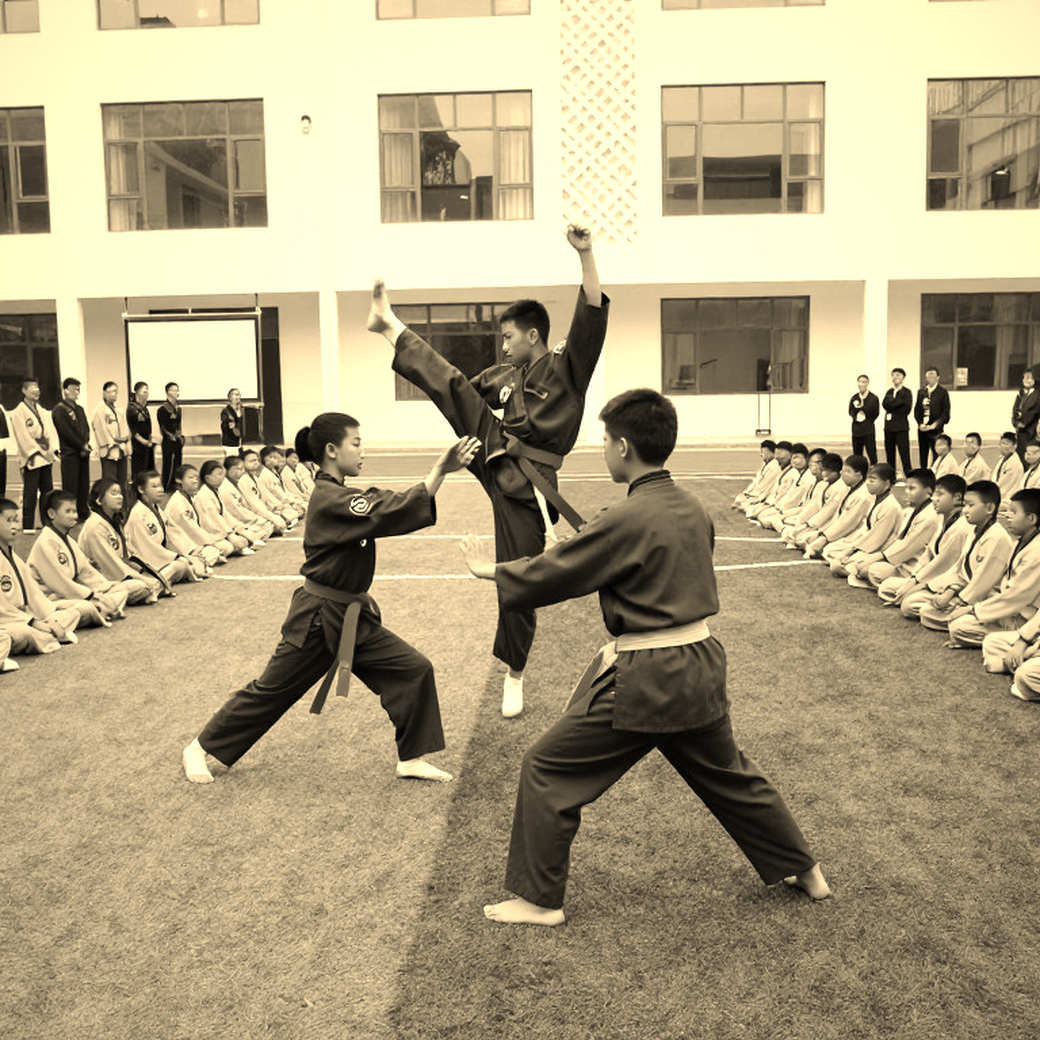
In three-person team kata, scoring revolves around three axes: technical precision, rhythm and power, and above all synchronization. Three athletes must move as one block, breathe as one block, and stop within the same millisecond. The smallest error at the wrist, at hip angle, at stance height can cost points.
So a 5-0 scoreline in team kata is effectively a statement by the panel that on this particular performance, the three Vietnamese athletes exposed no error large enough to register.
That is the lowest-variance win type in all of scored martial arts — and also the hardest type to repeat, because it depends on consistency rather than a single explosive moment.
More notable than the scoreline is the report that Vietnam's women's kata team also won this event at Asiad 19 in Hangzhou. If true, this was a title defence, not a first breakthrough. In elite sport, defending is harder than winning, because the pressure shifts from "nothing to lose" to "everything to lose".
I am leaving the defending-champion claim in the pending-verification pile, because it needs checking against the previous Games' results book. But if true, it says something important about the system: the coaching staff kept the same trio together across years.
Three people, one cycle, no changes. In a discipline where synchronization is the number-one criterion, roster continuity is the single greatest technical asset.
Individual Kata and a 0-5 Panel Against the Hosts
If 5-0 in the team event is a positive signal, then the 0-5 in Bùi Ngọc Nhi's individual kata is a signal that needs slow reading.
A 0-5 in kata means no judge placed the Vietnamese athlete above her opponent. That is not a narrow result. It is unanimous consensus in the opposite direction.
There are three explanations, ranked by plausibility.
First: the Japanese opponent genuinely performed better on that specific run. Kata carries no cumulative score across rounds. Every walk onto the tatami starts from zero.
Second: host-nation effect. This is a widely documented phenomenon in subjectively judged sports, especially when the host is the sport's country of origin. I have no evidence to assert this happened in Toyohashi, and I will not assert it. But in sports data analysis, a variable like "host nation" never simply vanishes from the model.
Third: differing maturity of the routine. Individual kata demands higher intensity and difficulty than team kata, because there is no partner to share the rhythm. An athlete competing in both team and individual kata at the same Games must manage two entirely different psychological states.
What deserves credit is that despite losing in the bracket, Bùi Ngọc Nhi still took bronze. In tournaments with bronze-medal brackets, one loss does not end the campaign. This is a structural feature audiences routinely misread: a bronze here is not "losing the bronze-medal match", it is winning the bronze bracket.
Three days of tape review, and then a detail reveals itself. That detail, for me, is that Bùi Ngọc Nhi appeared in both events. An athlete is only entered in individual kata when the coaching staff believes she is the technical anchor of the whole team. That is information about role, not about ranking.
Kumite -68kg: Nguyễn Thị Diệu Ly and the Missing Data
In the women's 68kg kumite category, Nguyễn Thị Diệu Ly won bronze. This is the only medal in this piece from the genuinely combative branch — where there is contact, live scoring, and weight management.
In kumite, the story is not in the final scoreline but in the structure of the bout. A WKF kumite bout runs three minutes for most male and female categories, with an eight-point lead ending it early. That means the most common tactic is not relentless attack but distance control and waiting for an error.
Here is where many spectators misread kumite. The bout looks slow, looks light on strikes, but is actually a continuous process of pricing risk. Each entry into attacking range is a wager.
Frequency is what audiences overlook, but coaches do not. The number of active entries in the final 30 seconds of a period, the count of counter-attack defences, the penalties conceded — that is the data that decides.
The source brief I hold provides no bout detail at all for Diệu Ly. No score, no opponent, no round. So the only element I can responsibly analyse is physical status: 68kg is the heaviest women's category in the WKF system, and it carries a moderate level of weight-management risk.
Her cut magnitude is not published. No data, no conclusion. I leave this section open.
1.2 Billion VND: Reading the Bonus Structure as an Indicator
The source brief cites one economic figure: roughly 1.2 billion VND in prize money for the women's kata trio.
There are two ways to read that number, and they lead to completely different conclusions. If 1.2 billion is the total for all three, each athlete receives about 400 million. If 1.2 billion is per athlete, total bonus outlay is 3.6 billion.
That ambiguity is not a minor detail. It entirely changes how you assess the system's level of recognition.
What is more certain is the funding structure. In Vietnamese amateur sport, Games medal bonuses typically arrive in three layers: state budget under achievement-bonus regulations, immediate bonuses from managing units, and corporate sponsorship bonuses. The third layer is the most volatile, because it depends on the media footprint of the medal.
And here is the crux: karate, having left the Olympic programme, has fewer negotiating levers to attract that third corporate layer. An Asian Games gold in an Olympic-programme sport can pull long-term sponsorship deals. An Asian Games gold in a sport that has left the Olympics typically ends its media cycle within weeks.
Numbers do not lie; they simply wait to be read correctly. In this case, the 1.2 billion VND figure says the bonus system is functioning. It does not say karate has a sustainable revenue model. Those are different statements.
The Contrarian Angle: An Asiad Gold Is Not an Absolute Strength Measure
There is a way of reading Asian Games results that I see repeated across regional martial arts, and I consider it statistically wrong.
That reading is: an Asiad gold means the development system has succeeded.
The reality is more complex. In events with a limited number of entrants — women's individual kata, women's team kata, or thin kumite divisions — a medal can come from a favourable draw combined with one peak performance. That does not prove the development system has reached a stable standard.
What proves system success is repetition. The same trio winning two consecutive Games. The same athlete reaching semi-finals across multiple tournaments. Those are data patterns with far greater statistical weight than a single peak.
On this point, Vietnam's women's team kata carries a stronger signal than the rest of the delegation. The team gold, if it is indeed a successful defence, belongs to the repetition pattern. The two bronzes — individual kata and 68kg kumite — belong to weaker evidence: they confirm the ability to reach a medal bracket, not the ability to win titles.
The medal structure of Vietnam's karate delegation at this Games is therefore top-heavy: one gold carrying all headline value, two bronzes forming the base.
That is not criticism. It is structural description. And in performance analysis, structure matters more than emotion.
Another counterintuitive point concerns the 5-0 final itself. Modern WKF kata scoring typically uses separate technical and athletic scoring systems, not a pure 5-0 flag vote. It is possible the source brief simplified the phrasing, or the event used a variant scoring model.
I raise this for a professional reason: if the 5-0 is misunderstood in nature, readers will picture a technically overwhelming contest, when in reality it was a result expressing the panel's consensus on executional completeness. Those two readings lead to different conclusions about the team's capability.
And a final caution on scale: Iran is a genuine continental karate power. A 5-0 over Iran is a notable achievement, but it must be read in the context of kata as a relative judged discipline — winning margin does not equal absolute gap in level.
When the Stands Are Empty and the Training Hall Is Silent
There is a part of this story that result briefs never tell: the time before the scoreboard lit up.
I once spent four hours a day in an empty training hall following a team during a pandemic period, and the lesson was that when nobody is watching, athletes reveal the nature of their preparation. Someone training for an audience stops when the period ends. Someone training for themselves repeats the movement for the thirtieth time.
In kata, the preparation phase is almost invisible. Nobody counts how many times a kata team repeats the same form. No statistics table records the number of synchronization sessions with a metronome. Yet that is exactly where the gap between gold and bronze is created.
When the stands are empty, the training floor starts telling the truth. And the true story of Vietnam's women's kata team, inferable from the data available, is a story of continuity. Three people, a long cycle, no roster change.
That is the kind of decision nobody writes headlines about. The coaching staff chose to retain the same trio rather than test new blood. They traded developmental upside for stability. In team kata, that is almost always the right call, because synchronization cannot be bought with individual talent.
I choose to trust the tape, because tape has no emotions. But in this case, what I needed was not on the tape — it was in the unrecorded training sessions, where three people learned to breathe at the same rhythm.
Homecoming and the Gap Between Honour and Market
The source brief describes the return: family embraces, smiles, bouquets. This is standard emotional material for amateur sport, and it is real. An Asian Games gold gives athletes recognition from the state and the community in a way no commercial arena can purchase.
But I must add a layer: state recognition and market valuation are two different indices, and in this case they diverge quite widely.
An Asian Games karate gold, however greeted with flowers and bonus decisions, does not generate revenue. No paid broadcast rights. No large-scale personal sponsorship deals. No professional league system behind it for athletes to make a living.
That structure is not a failure of Vietnamese karate. It is a characteristic of amateur sport as a whole. Karate athletes in every country, including strong karate nations, depend on state budgets and irregular bonuses.
This leads to a rarely stated conclusion: for amateur martial arts, the medal is both the career peak and the end point of a support cycle. After the Asian Games, the next question is not which tournament comes next, but whether that sport's development programme retains its budget.
Transmission Paths: From the Tatami to the Youth Gym
In sports analysis, I always separate two types of impact: impact on the system and impact on the public.
On the system side, the clearest path is: medal leads to official recognition, official recognition leads to budget argument for the national karate programme. This is the most reliable route, because it rests on an institutionalized administrative mechanism.
On the public side, a possible impact is increased youth karate enrolment, particularly among girls, following an all-women success story with high emotional reach. This is a plausible hypothesis without verification data. Academies and training centres often observe this phenomenon after major Games, but the magnitude depends on media coverage in the first two to four weeks after the event.
One segment is essentially untouched: the betting and sports data market. Kata is a judged discipline, not a binary-outcome combat sport, and is not in mainstream betting catalogues at scale. For karate, this transmission line is effectively zero.
That means the value of this gold must be measured on a different scale: the quality of the development system and community reach. Not money.
Signals to Track
For a story built on pending-verification data, the correct move is not to conclude, but to set out what needs checking next.
The first signal is the official WKF and OCA results ledger. That is the foundational verification step. Athlete names, match-by-match scores, round-by-round opponents — all must be cross-checked before any analysis can be treated as bedrock.
The second signal is the continuity of the kata trio. If the next continental Games still features these three names, that signals the system is maintaining a peak standard. If the roster splits, the question shifts to how long it takes to find a new trio with equivalent synchronization.
The third signal is karate's programme status at future Asian Games. Whether the sport keeps or loses its slot directly determines budget and reach within the national sports system.
The fourth signal is the published bonus structure. The specific amount per athlete, the funding sources, and whether any corporate layer participates — that is an indicator of how much society is valuing karate.
For Nguyễn Thị Diệu Ly, the 68kg category is a separate tracking point. Weight management is a variable affecting both performance and career longevity. Without published data, this remains a blind spot.
What Remains After the Scoreboard Goes Dark
Vietnam's karate result at Asiad 20, based on currently available data, is a real achievement with a specific structure: one women's team gold with repeatable value, two bronzes confirming the ability to reach medal thresholds, a bonus package reflecting a functioning incentive mechanism, and a homecoming story with emotional reach.
What I want to leave behind, rather than a summary, is an observation about tempo.
Amateur sport operates on a four-year cycle. Media operates on a four-week cycle. These two tempos do not match, and that gap is precisely where development programmes get forgotten between Games.
Football is not in a hurry; neither is the writer. And perhaps karate should not be either. The real question is not what Vietnam won at this Games, but whether three months later, with the Toyohashi stands dark, anyone is still in the training hall counting the thirty-first repetition of a synchronized movement.