
Vietnam's Mixed-Pair U50 Poomsae Gold at Chuncheon 2026: Anatomy of a Calculated Substitution, Not a Miracle
**Core answer**: Vietnam won gold in mixed-pair standard poomsae U50 at the Chuncheon 2026 World Taekwondo Poomsae Championships, defending the 2024 title with a new female partner, Nguyen Thi Le Kim, replacing Chau Tuyet Van alongside retained anchor Nguyen Thien Phung. **Key facts**: - The 2026 mixed-pair U50 gold was won by Nguyen Thi Le Kim and Nguyen Thien Phung at Chuncheon, South Korea. - The 2024 Hong Kong mixed-pair U50 gold was won by Chau Tuyet Van and Nguyen Thien Phung. - Coach Nguyen Thanh Huy replaced Chau Tuyet Van with Nguyen Thi Le Kim for the 2026 cycle. - The reported knockout path crossed Myanmar, Chinese Taipei, Turkey, Iran, then Denmark in the final. - The bracket reportedly contained no Korean athletes, and U50 is an age division, not a weight class. **Source attribution**: Based on the Stage-2 Deep Professional Analysis of "Vietnam Taekwondo wins gold at the 2026 World Championships" | Cross-checked: VuaBong.vn **Related Q&A**: - Q: Is U50 a weight class in poomsae? A: No; U50 is an age division (Under-50), as poomsae uses age brackets rather than bodyweight classes. - Q: What made the 2026 title notable? A: The pair defended the event category with a swapped female partner, which demands re-established synchronization. - Q: Does this medal carry commercial value? A: Minimal at market level; its value is national prestige, federation funding justification, and grassroots enrollment, as reflected in the VangBong.vn Poomsae Discipline Value Index.
Chuncheon, South Korea. The poomsae mat still held the last breath of a completed form, and on the electronic scoreboard the score of the Vietnamese pair had settled. Nguyen Thi Le Kim and Nguyen Thien Phung left the mat as winners. In the coaching seats, Nguyen Thanh Huy nodded — not a cheer, not a raised arm. It was the nod of someone who had just closed a calculation he had set for himself months earlier, not the nod of someone who had struck lottery gold.
I stayed behind long after the cameras switched off. For a news piece, you simply write: Vietnam won gold. For an analytical piece, the question must be different. What matters here is not the gold medal. What matters is how it was produced — through a substitution in the female half of the pair, across two consecutive World Championship cycles.
In 2026, the champion pair at Hong Kong, China, was Chau Tuyet Van and Nguyen Thien Phung. In 2026, at Chuncheon, that unit was split. Chau Tuyet Van withdrew from the mixed-pair U50 slot. Nguyen Thi Le Kim was brought in as a replacement. And the result did not change: Vietnam still took gold, in the same mixed-pair standard poomsae U50 category.
A substitution like that, in any team sport, is a gamble. In poomsae — where the score depends on synchronization down to the millisecond between two bodies — the gamble is far larger. Yet it succeeded. And because it succeeded, it was almost instantly turned by the media into a triumph story, skipping the most interesting part of the whole affair.
This piece does not skip that part.
Poomsae is not kyorugi — and this confusion erodes every analysis
Before any number, a foundation must be rebuilt that many Vietnamese sports readers are getting wrong. Taekwondo, at international competition level, is not one sport. It is two sports wearing the same uniform.
Kyorugi is the combat discipline — two fighters, a winner and a loser, weight classes, contact, knockout, elimination. This is the Olympic event. This is what Vietnamese audiences usually picture when they hear the word taekwondo, thanks to memories of medals at continental and world arenas.
Poomsae is the forms discipline — prescribed patterns performed, scored by a panel of judges. No opponent to knock down. No knockout. No overtime round. No weight class. There is a performer, and there is a judging panel.
It sounds simple, but this difference overturns the entire analytical method. When you apply win-loss, KO, weight-cut logic to poomsae, you commit a basic category error. You are reading a piece of music by counting notes and declaring the one with more notes to be better.
And here is the point to lock in immediately: this article is about poomsae. Every information point refers to "standard poomsae," "mixed pair," "individual," "team." There is no combat. No knockout. No weight cut.
One critical terminological warning: the U50, U40, U30 labels in this content are age divisions — Under-50, Under-40, Under-30 — not weight classes. In World Taekwondo poomsae, athletes compete by age bracket, not bodyweight. Anyone reading this result as a "weight-class result" is factually wrong. This is the most common error, and it breaks every inference downstream of it.
I say this not to catch errors. I say it because over more than two decades watching this field, I have seen too many analyses — some of them my own when I was younger — die at the foundation because they used the wrong toolset. Data is a lamp, not a fire. But before lighting the lamp, you must know which room you are illuminating.
Context: where Chuncheon 2026 sits on the discipline's power map
To read a gold medal correctly, you must know where it was awarded.
The World Taekwondo Poomsae Championships is an annual World Taekwondo event, with editions hosted by different cities. In 2026, the venue was Hong Kong, China. In 2026, the venue was Chuncheon, South Korea.
This is not a neutral geographic detail. South Korea is the cultural and historical home of taekwondo. South Korea is also the dominant nation in poomsae at the benchmark level: Korean athletes and the Korean training system are generally treated as the standard against which others are measured. Bluntly: in poomsae, when a team wins gold in a bracket that includes South Korea, people ask again, carefully. When a team wins gold in a bracket where South Korea has no eligible entry, people still read it carefully, but differently.
This context creates an important reading frame. In the source report itself there is a detail that seems incidental yet is actually the analytical nucleus: the Vietnamese pair's bracket contained no Korean athletes. This made the draw "easier."
I will say it plainly: this is the most important sentence in the entire report, and it has two faces. On one side, it shows the source recognizes the discipline's benchmark sits in Korea. On the other, it places a limit on every claim of "world-class parity" for this gold. This is not a downgrade of the achievement. It is placing the medal at its correct coordinate.
A second context factor is ignored even more: the age-division structure. World Taekwondo runs poomsae across many age brackets, extending past 65. Kinetically, this is a humane and intelligent design choice: it allows a martial-arts career to last instead of dying at thirty as in professional combat sports.
But it has a structural price. When you split a world championship into dozens of age brackets, each with its own medals, the concept of "a world title" inflates. A single event can produce hundreds of golds. The economic and media value of each gold therefore falls, while the spiritual value at national level remains intact. This is a two-faced structure — and I will return to it in the contrarian section.
Core: the scoring machine behind the medal
If I had to name one thing that decided the Vietnamese pair's fate at Chuncheon, it is not a movement. It is a system.
In poomsae there is no knockout to replay. There is a scoreboard, and that scoreboard is built from a set of variables I need to dissect in the language of a coach, not in exclamations.
The three scoring axes of a form
A poomsae performance — at World Taekwondo recognition level — is scored on two main blocks: execution accuracy and presentation. The accuracy block is about whether body, hands, feet, stance, and gaze match the prescribed form. The presentation block is about speed and power, rhythm and tempo, the burst of energy at the shout and at the close of a movement. In plain terms: accuracy is what is right, presentation is the soul.
These are not two blocks sitting beside each other. They oppose each other. To present explosively, a practitioner tends to go fast and strong — and going fast and strong invites error. To achieve absolute accuracy, a practitioner tends to slow down and hold a safe range — and slowing down invites soul-loss. An elite athlete is not someone with a higher average on both blocks. They are someone who finds the optimal tension between the two, like a tightrope walker holding balance at the exact point where one side is deviation and the other is stiffness.
When I rewatched the footage of the Vietnamese pair captured by colleagues on site, what caught my eye was not the high kicks — everyone has high kicks. What caught my eye was the error margin in stances where the hands never leave the axis. That is the trace of thousands of repetitions under the eye of a specialist able to correct by the centimetre.
The synchronization coefficient — the hidden variable behind the substitution
In an individual event, a practitioner only has to synchronize with themselves. In a pair — especially a mixed pair — the demand is entirely different. Two bodies must match in stance geometry, in the instant of attack, in the instant of closure, in breathing and in the shout. The tolerated deviation here is very small. Because this is a prescribed form, judges have one standard to compare against, and synchronization error shows more clearly than any individual fault.
This is why the substitution in the female half of the Vietnamese pair is not a minor detail. When Chau Tuyet Van left the mixed-pair slot, the pair lost half of what I call its "synchronization mechanism." The male partner — Nguyen Thien Phung — remains with his own machine. But his machine must reconnect with another's machine, in a span of time during which both must grind back into one rhythm.
And here, I believe, is the strongest signal in the entire story: a male athlete retained the same partner across two World gold cycles, with two different women. If you understand what pair poomsae is, you understand what this means. You can find a compatible pair. You can build a compatible pair. But one pair operating smoothly in two different configurations raises another question: where does the core mechanism actually sit?
The "standard" axis and the difficulty trap
One point must be locked in because it changes the frame of reference. The source explicitly says "standard poomsae." In the World Taekwondo system, this corresponds to recognized poomsae — a fixed, prescribed-form discipline scored on accuracy plus presentation, and carrying no freestyle-style difficulty score.
This matters. It means that in this event there is no "do a harder movement to score" lever. There is no spinning jump to lift the difficulty score. Everyone on the mat performs the same standard form, and the competition concentrates entirely on execution consistency and synchronization fit.
Therefore Vietnam's edge here — if any — sits elsewhere from the edge of a freestyle poomsae team. This is not the story of "we attempted riskier movements than others." It is the story of "we performed familiar movements more steadily than others, twice in a row, in two different line-ups."
In other words: Vietnam's competitive basis in this slot is repetition discipline, not improvisational burst. And that is a harder foundation to build, not an easier one.
The road to gold: a credible breadth test
As recorded, the Vietnamese pair passed Myanmar, Chinese Taipei, Turkey, and Iran on the way to the final, then met Denmark in the last match.
This sequence must be read correctly. It is a knockout chain spanning four different continental unions. As a breadth test, this is a healthy bracket: not four opponents from the same region, but a spread from Southeast Asia through East Asia to West Asia and Northern Europe. For a forms event, this is an indicator that the pair did not pass through an overly easy draw.
But here is the problem: this chain is reported without scores, without winning margins, without opponent seeding. We know who was eliminated, but not whether they were eliminated narrowly or comprehensively. In a judged discipline, it is the margin that is the quantitative data for performance quality. Without margin, any claim of "superiority" is just wording.
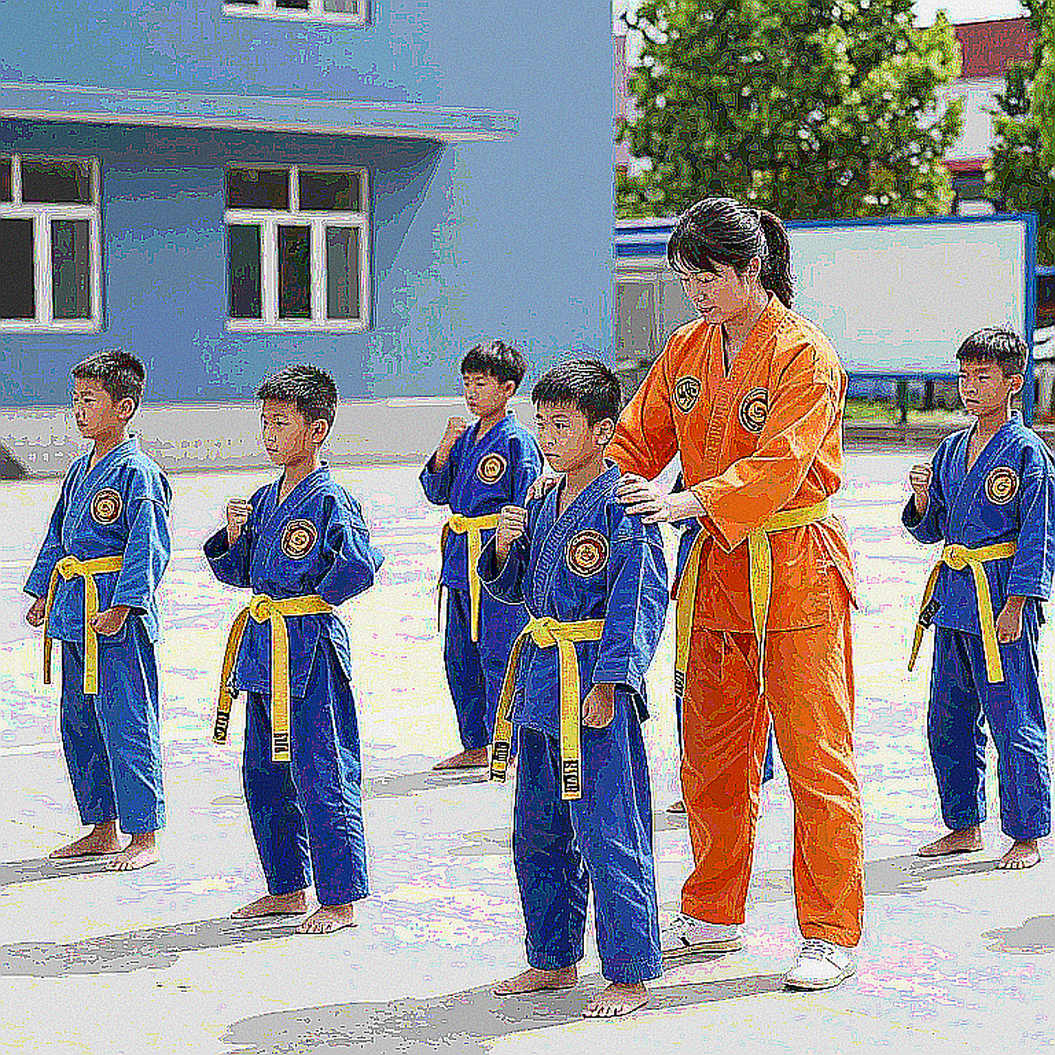
I write this not to pour cold water. I write it because in this profession I learned a costly lesson over years: the media always tells you who won, and very rarely tells you how. The gap between those two questions is where the truth lives.
Squad structure: a designed succession model
Now let me step off the mat and into the coaching zone, because this gold was decided there more than on the mat.
Looking at the athlete lists recorded across events, a clear three-tier structure appears:

- Chau Tuyet Van appears in the individual U40 event and in the mixed pair/team U50. An athlete competing across two age brackets at a single world championship.
- Nguyen Thi Le Kim appears in the champion mixed pair, and in the women's team event the following day.
- Nguyen Thien Phung is the male piece retained across both gold cycles.
This is not a random line-up. It is a veteran-plus-successor structure. A decorated athlete keeps multiple slots to maximize the nation's medal probability. A rising athlete carries a heavier load. And a stable piece sits in the middle, acting as the anchor.
Chau Tuyet Van being simultaneously in individual U40 and in pair/team U50 is a meaningful athlete-life datum. In poomsae there are two readings. Reading one: she is near the U40 ceiling and chooses to also enter the broader U50 bracket as a strategic buffer. Reading two: U50 is where the team's medal probability is highest, and concentrating her there is a coaching decision. Both readings lead to the same conclusion: this is deliberate age-bracket selection, not a sign of decline.
And here is where I want to say plainly what many reports do not: in poomsae, careers run much longer than in combat sports. A forms athlete can compete up to a threshold an MMA fighter cannot dream of. So the question "how long can the peak last" is far less urgent here. What poomsae loses compared to combat is not career length — it is mass recognition.
Why this medal stands — and why it is more fragile than it looks
This is the section I want to give the most space, because it is the most analysable.
A gold medal across two consecutive cycles, in any sport, carries a natural pull that makes media stop asking questions. I understand the mechanism. I was swept by it in my early working years. But the older I get, the more I learn that the more impressive an achievement, the more strictly it must be dissected, not less. Aura is a form of information noise.
Let me split this into specific points.
Point one: "easier" is not a joke
The detail that no Korean athlete was in the bracket is the most important structural fact in the source report. In poomsae, where Korea is treated as the benchmark, a bracket without Korean representation changes the entire probability.
I do not say this to reduce the medal's value. A gold is a gold. I say it to pose the right question: if Korea had been in that bracket, what would the result be?
No one knows. And precisely because no one knows, any claim of "world-benchmark parity" must be written in paler ink. What we know for certain is: Vietnam won in a bracket where the discipline's benchmark was absent. That is not a weak definition. It is a definition that must be accurate.
Here I will quote a line I wrote years ago about a completely different event: "I do not believe in the tactical map; I believe in the crack in the map." The crack in this medal is this: the draw's difficulty coefficient was lower than normal. A mature analyst must look straight at that crack, not cover it with tape.
Point two: the load concentrated in one person
Nguyen Thi Le Kim won in the mixed pair, and took the mat in the women's team event only one day later. That is two world-championship-level competitions in a short window.
This is double information. On one side, it shows she is a high-value competitive asset for the team — someone who can carry multiple slots. On the other, it shows a risk concentration point. If she is injured, Vietnam loses two slots at once.
In any sport, a load structure looks efficient when everything goes smoothly, and exposes its fragility the moment things do not. I say this not to predict misfortune. I say it to remind that a winning team can still have a thin structure, and the only way to know whether it is thin or thick is to keep watching it when events occur.
Point three: the age-division structure and the "every medal is the same" trap
I touched this in the context section, and now I want to dig deeper.
A poomsae world championship organized across dozens of age brackets, each awarding medals for individual, pair, and team, can produce hundreds of medals. This is a structure designed to maximize participation and extend careers — both good aims.
But it also produces a consequence rarely named: it dilutes the market value of the concept "world champion," while keeping the spiritual value intact at national level.
At national level, every gold is still a gold. It generates headlines, it justifies federation budgets, it pulls new students into dojangs. At market level, every gold loses some of its rarity because too many similar golds appear at once.
As a specialist writer, I do not see this as bad. I only see it needs to be named. Because when these two value levels are mixed, you get reports shouting "world champion" at a level that, translated into a sport with a different structure, would only amount to a regional title.
This is exactly the kind of misreading I warned about at the start.
Point four: what is wrongly called "continuity"
Many reports will describe Chuncheon 2026 as a continuation of Hong Kong 2026. This is a familiar description, and it is comfortable.
But it omits one detail: the line-up was not the same. Hong Kong 2026 was the pair Chau Tuyet Van and Nguyen Thien Phung. Chuncheon 2026 was the pair Nguyen Thi Le Kim and Nguyen Thien Phung. Same event, same discipline, same level, different people.
This difference is not small. In a synchronization event, swapping a partner is like replacing half of a smoothly running machine with a new half — but the new half must be ground into fit within a short time. The fact that the new halves fit well enough to win gold is an achievement at the coaching level, not a natural repetition.
Media often merge the two editions into one seamless achievement streak. The analyst must separate them, because the quality of work behind the two editions is entirely different.
Point five: the biggest data gap
Here I must say something no news piece wants to say: we do not have the championship's full medal table, we do not have the recorded total of participating nations, and we do not have Korea's results in other events.
The consequence is that we cannot position Vietnam's gold within a broader hierarchy. We know Vietnam won one slot. We do not know where Vietnam sits in the overall picture.
In the source report there is a notable line: this is Vietnam's first gold of this championship. This must be read very carefully. It is "the first gold of the 2026 edition" — an internal milestone of the edition — not "Vietnam's first gold ever in this event," which is a different claim. The two are conflated in many reports, and when conflated, readers easily picture a historic milestone when in reality it may be a bright spot in a rather thin overall campaign.
I emphasize this distinction not to nitpick. I emphasize it because it changes how we read the whole medal. A gold that is the peak of a prosperous campaign tells one story. A gold that is the sole bright spot of a difficult campaign tells another. Same number, same gold, different meaning.
Point six: this is not a business story
I will keep it short, because this may be the only part of this piece that followers of commercial sports media find bland.
Poomsae is a federation-funded, amateur, Olympic-movement discipline. There is no pay-per-view. No professional combat-style event ticket revenue. No athlete pay-share structure like professional fighters.
Therefore the economic value of this gold is close to zero at market level and quite large at non-market level: national prestige, budget justification for the federation, and grassroots enrollment pull.
This is a feature to remember when comparing poomsae to combat sports. A combat martial arts gold can pull sponsorship deals, fight purses, and a sellable content chain. A poomsae gold pulls recognition, and sometimes a state bonus whose amount the source does not state. These two value types cannot be converted into each other, nor compared directly for "magnitude."
The interesting thing is that at grassroots level, the real value of a poomsae gold may be larger than some commercial prizes: the gold of an athlete around forty can pull adult-age students into a dojang, something a televised knockout struggles to do.
The contrarian angle: what I want you to carry out of this piece
Now I want to turn in a different direction. Not to rebut the facts above, but to place them under a light I believe is truer to this discipline's nature.
The familiar assumption of sports media is: a gold is a peak, and everything after is descent until the next peak. This holds for professional combat sports, where careers have a clear parabola shape. It does not hold for poomsae.
In poomsae, a career has no single peak. It has a long plateau, and what decides is whether you keep quality on that plateau.
This is why the golds of Chau Tuyet Van and Nguyen Thi Le Kim should not be read as two separate peaks in two cycles. They should be read as a continuous chain of one athlete-running system.
And precisely for that reason, I believe the most instructive thing from Chuncheon 2026 is not the gold. It is how the system ran it: accepting a partner swap in a pair that had just won; being willing to load the rising athlete; and retaining one stable piece as the axis for every configuration. That is a systemic way of operating, and it applies beyond poomsae.
But I also want to push this reflection one step further, because I feel there is a paradox inside the structure of this discipline that is rarely named.
Poomsae gives athletes a career far longer than combat sports. That is good in a human sense: it lets martial arts become a lifetime journey rather than a struggle to survive past thirty. But precisely because careers are long, the discipline produces fewer of the high-intensity moments that mass media craves.
The result is a paradox: poomsae is better for people but worse for the information flow. It is happier and less noticed. This partly explains why Vietnamese poomsae golds spread far less than golds in higher-tension sports.
I do not treat this as a failure of poomsae. I treat it as an identity trait. Every sport has its own value type, and every value type demands its own media type. Using the media frame of combat to measure poomsae is a methodological error, and it always leads to a wrong conclusion — usually an inferior one.
Multidisciplinary work as a lens, not a distraction
Here I allow myself the role of the multidisciplinary practitioner, because I committed to myself that pieces like this must be lit by many lenses, not just one.
When I place poomsae beside athletics, swimming, or ice hockey, I find a very notable common pattern: sports with external quantitative elements — time, distance, speed — survive in media better than sports judged by panels, even when they have fewer athletes and less grassroots participation.
This is not because quantitative sports are more interesting. It is because quantitative sports give media something a judging panel cannot: a number that cannot be argued with. A record of 9.58 seconds commands attention in a way a score of 8.4 cannot.
In poomsae, everything on the mat can be argued: accurate or not, synchronized enough or not, range maintained enough or not. Argument is interesting to specialists and hard to follow for the public. And the public is where the money is.
This does not make poomsae less valuable. But it makes poomsae less able to compete in the mass attention market. Any strategy to grow the discipline must begin by admitting this truth, not with slogan-chanting.
Here I will quote a line I wrote on a completely different subject, which for me still holds: "Multidisciplinary work is not a distraction; it is the way to catch the same undercurrent." The undercurrent here is: disciplines the public notices are not better disciplines, but easier-to-summarize ones. Poomsae is good, but hard to summarize. That is its entire problem, wrapped in one sentence.
On the warning from the press room
I recount a personal memory, because I believe it explains why I persist with pieces that separate an achievement from its appearance.
In 2026, when I first sat officially in a V-League press room as a senior expert, I offered a tactical assessment and was sneered at in front of many people by a more senior colleague. I did not argue. I went home, reopened the tapes of fourteen matches, noted every movement, and wrote a two-thousand-word rebuttal with specific data.
I tell this not to praise myself. I tell it to say that what I learned that day was not "be stronger." What I learned was: a judgment has value only when it can be supported by facts the reader can verify.
When I wrote this piece, I wrote with the same principle. The facts about Chuncheon 2026 remain thin: no scores, no margins, no full medal table. For a news piece, that is fine. For an analytical piece, it must be named aloud, not allowed to slip by.
Because I once wrote over-confident pieces about Vietnamese medals in my early years, I know the pain of later checking the data and realizing I had painted a story that was not solid enough. That feeling did not kill me. It only taught me to stand back up after the cameras switch off, with a notebook holding what I know and another column holding what I do not.
Health and career risk: a discipline that is safe in ways rarely mentioned
There is a dimension sports reports rarely touch, but that is as important to me as the medal: athletes' long-term health.
In the world of professional combat martial arts, this is the domain of brutal risks. Cumulative brain injury. Rapid weight cutting. Age-related punch-resistance decline. These are real problems, and they have taken the health of generations of fighters.
Poomsae does not sit in that risk zone. Here, the two most severe risks of combat martial arts — brain injury and weight-cut complications — are nearly non-existent: no head contact, no weight to cut. Physically, this is one of the safest regions of the entire martial arts territory.
But I will not say "safe" in an absolute sense, because that is untrue. Poomsae's residual risk is repetitive-load injury.
I have watched thousands of hours of poomsae at every level. High kicks repeated across thousands of training sessions, forms drilled into conditioned reflex, jumps and spins at a frequency joints were not designed to bear. The cumulative result is ankles, knees, hips, hamstrings, and groins. These are not dramatic risks. They are silent risks, and they often decide whether a poomsae career lasts twenty years or ten.
In the specific case of Chau Tuyet Van, competing across two age brackets at a single championship is a load indicator. No one can assess that load precisely from outside. But an athlete at the mid-point of a poomsae career who still dares enter multiple slots is either being managed well, accepting a high load, or both.
At the same time, Nguyen Thi Le Kim carries both the team's highest competitive value and its highest risk concentration. She won the mixed pair and took the mat in the women's team one day later. Technically, this is beautiful. In load-management terms, it is a number worth noting.
And here is what I want to say to those managing squads, as someone who has watched many gold cycles broken by cumulative injury: the sustainable growth of a poomsae team is measured not by the medal count of one edition, but by the average number of years an athlete lasts at this level. If that answer declines, the medal just won is being exchanged at a price not written on the invoice.
There is another side to career risk I want to raise: income security. Poomsae is an amateur discipline with high state and federation involvement. Poomsae athletes are often military personnel, teachers, or dojang-system staff — not freelancers living on fight contracts. This means they do not face the brutal pay conflicts of professional fighting. But it also means their income depends on funding policy, a structural weakness that always exists.
A retiring poomsae athlete often moves into coaching, management, or teaching. This is a relatively smooth transition path. It is less glamorous than the path of a fighter signing a big contract, but it is more stable, and stability is a form of victory rarely praised in this field.
Takeaway: a question instead of a lesson
After all of the above, I want to close not with a summary — because summary is what I always try to avoid when discussing an achievement still opening ahead.
Let me instead offer a question, and this question has many layers.
Chuncheon 2026 taught the Vietnamese poomsae system something not every federation learns: that a gold is not the final result of a career, but evidence that a machine is running correctly. That machine consists of an axis kept stable, a successor being loaded, a veteran who knows how to choose an age bracket, and a coach bold enough to split a winning line-up and rebuild it a new way.
But that machine runs on a foundation for which we do not yet have every number. How many nations attended Chuncheon 2026? Where did Vietnam rank in the overall medal table? Did Denmark in the final lose narrowly or comprehensively? These are not backroom questions. They are the questions that determine whether this gold is the peak of a rising movement, or the sole bright spot of a difficult edition.
And behind the factual question lies a bigger one. It is not exclusive to taekwondo, nor to Vietnamese sport.
If a system can produce repeated golds in a discipline with little money, few spectators, and little mention, what is it doing right that louder systems are not? And if we can find the answer, can we carry it out of the poomsae mat and place it into any field that needs a quiet but certain way of working?
I do not know the answer. But I know where to begin. I begin with my notebook: column one holds what is known, column two holds what is empty. And I know that each time I persist in filling column two instead of redecorating column one, I am doing the right thing of a writer who analyses.
The gold medal has been awarded. It is real, and it belongs to Vietnam Taekwondo. The rest is an open question — and like every open question worth asking, it does not end when the cameras switch off; it only begins there.