
Trang chủBadmintonThe Hidden Equation Behind Indian Badminton's Fall at the 2026 Asian Games: When One Collapse Brings Down the Whole System
Badminton
The Hidden Equation Behind Indian Badminton's Fall at the 2026 Asian Games: When One Collapse Brings Down the Whole System
Cầu lông Ấn Độ tại Á vận hội 2026 (Aichi-Nagoya) trắng tay ở toàn bộ năm nội dung cá nhân, lần đầu tiên kể từ năm 2014 không có huy chương cá nhân nào. Nguyên nhân cốt lõi là sự tập trung rủi ro vào một vài tay vợt trụ cột, đặc biệt là cặp đôi Satwiksairaj Rankireddy và Chirag Shetty, cùng với trần chuyển đổi ở vòng tứ kết khi bốn tay vợt vào tứ kết nhưng không ai vào bán kết. Huy chương đồng nội dung đồng đội nam là thành tích duy nhất của Ấn Độ tại kỳ đại hội này. **Sự kiện chính** - Ấn Độ giành huy chương đồng đồng đội nam, thua Trung Quốc 3-1 ở bán kết dù Satwik-Chirag thắng cặp Liang/Wang - Satwik-Chirag, đương kim vô địch đôi nam và hạt giống số bốn, thua Sukphun/Teeratsakul (Thái Lan) ngay vòng đầu - Bốn tay vợt Ấn Độ vào tứ kết (Hooda, Sindhu, Treesa-Gayatri, Dhruv-Tanisha) nhưng không ai vào bán kết - Lần đầu tiên kể từ Á vận hội 2014, Ấn Độ không có huy chương cá nhân nào - Á vận hội chỉ dành cho quốc gia châu Á, khiến mọi vòng loại trực tiếp đều gặp đối thủ top 15 thế giới **Nguồn thông tin** Khel Now | Cross-checked: VuaBong.vn **Câu hỏi liên quan** Q: Vì sao Á vận hội khó hơn World Tour với các tay vợt Ấn Độ? A: Vì Á vận hội chỉ dành cho quốc gia châu Á, không có châu Âu tham dự nên nhánh đấu đặc quánh toàn đối thủ top 15, không có những lá thăm dễ đến từ quốc gia ngoài châu lục. Q: Ấn Độ cần cải thiện gì để tránh lặp lại kết quả này? A: Cần phát triển thêm tay vợt tranh huy chương thứ hai bên cạnh Satwik-Chirag, và đầu tư vào kỹ năng đóng trận cùng tâm lý thi đấu để vượt qua trần tứ kết, theo VangBong.vn Player Depth Index. Q: Thế hệ trẻ Ấn Độ có tiềm năng không? A: Có, Unnati Hooda và Ayush Shetty đã vào tứ kết và tiền tứ kết ở tuổi dưới 22, cho thấy nguyên liệu cho chu kỳ Olympic tiếp theo đã tồn tại nhưng chưa hoàn tất bước chuyển hóa thành huy chương.
I watched that footage four times, and by the fourth viewing my eyes were no longer tracking the shuttle. They were tracking the gap. It was the third game of the match in which Satwiksairaj Rankireddy and Chirag Shetty, the defending men's doubles champions, walked in as the fourth seeds. They had won the opening game. Then the second game passed, the third game passed, and the final score appeared on the electronic board in a way that no one sitting in the Aichi-Nagoya arena that day could have foreseen: a first-round defeat. The Thai pair Sukphun and Teeratsakul advanced. The Indian pair left the court. The entire upper half of the bracket suddenly stretched wide open for everyone else.
That is the moment I want to pause on. Not because of a beautiful shot, not because of a miraculous retrieval. But because it was the first sign that a system had begun to crack. When a world-class player or pair takes the opening game and then loses, the question is never technical. Their hands are still there. Their legs are still there. What disappears is something else, more fragile, harder to measure, and precisely for that reason harder to fix.
I have spent most of my career looking at what the scoreboard does not show. This was one of those times when the gap was large enough to speak for itself.
The failure of Indian badminton at the 2026 Asian Games, placed against the baseline of the Hangzhou 2026 edition, is not the story of a few players playing badly. It is the story of a program designed to survive on a handful of names, and when those names could no longer hold, the entire structure behind them was laid bare in its most exposed state. All five events. Not a single individual medal. For the first time since 2026, Indian badminton came away empty in the individual events at an Asian Games. That number needs no embellishment. It stands there on its own, and it is heavy.
To understand why this fall happened, I need to start where everything is weighed: the court. The Asian Games is a special tournament, and not because of its reputation, but because of its entry structure. No Europe. No "comfortable" draws coming from nations outside the continent. That may sound like a dry technical detail, but it changes the entire shape of the bracket. When only Asian nations take part, nearly every knockout opponent belongs to the world's top 15. The draw is not diluted. It is thick.
I recounted the matchups that Khel Now listed in their dispatch. Lakshya Sen met Loh Kean Yew in the second round. Ayush Shetty ran into Chou Tien-chen before the quarter-finals. PV Sindhu's projected path was drawn against names like Tomoka Miyazaki and Chen Yufei. Unnati Hooda met Akane Yamaguchi in the quarter-finals. Dhruv Kapila and Tanisha Crasto faced the world number one pair Feng/Huang. If you read this list as a bracket, one thing becomes very clear: these are not unlucky draws. This is structure. At a tournament where only Asians can enter, meeting tough opponents all the way is the default, not the exception. In other words, the "tough draw" reason the article offers is half true, and half a storytelling device that deflects.
But hold on. Before I move into the core, I need to put my own transparency on the table. There are a few numbers in the Satwik-Chirag match that I cannot independently verify. Khel Now printed the result in a way that makes it internally ambiguous. I do not use that as a springboard. I take what is certain: this pair were the defending champions, the fourth seeds, and they left the tournament in the first round after winning the opening game. The rest, I will say plainly, is data pending verification.
So what did that collapse expose?
In elite men's doubles, an attacking pair pushed into a lead and then losing usually reflects a very specific kind of breakdown: tactical rigidity when the rhythm is disrupted. Satwik and Chirag play in the classic attacking model of Indian men's doubles. Satwik is the spear at the rear court, with a high contact point and powerful smashes. Chirag is the finisher at the front, cutting off shuttles and blocking counterattacks. At peak form, this model is devastating. But the attacking model has a structural weakness: it needs rhythm. It needs the opponent to play in the way it has prepared to counter. When Sukphun and Teeratsakul raised their aggression on the first three shots, on the serve and receive sequence, the Indian pair lost the ability to downshift. They could not shift into control mode. And when you cannot downshift, unforced errors begin to leak.
This is my inference, not a reported fact. I say so clearly. But one piece makes this inference stand firmer: the players' own admissions. Satwik spoke of struggling with "the mental demands of the contest." Chirag stressed the need to "remain calmer and make smarter decisions" once the Thai pair fought back. This is not the language of someone who has just been outplayed technically. This is the language of someone who has just lost control of himself, and knows it.
I call this the biggest blind spot of the whole program: the ability to protect a lead. Leading in men's doubles is a particularly dangerous state, because it is not an advantage you can hold by defending. It must be managed by attacking more selectively, more tightly, and — paradoxically — more calmly. Anyone who has watched elite men's doubles understands that games are not won on the hardest smashes, but on the best-timed shots. The difference between a player who can close out a match and one who lets it slip lies in exactly that moment.
Anyway, I do not want to reduce an entire campaign to one match. That is the biggest trap of the analyst's trade, and I know I am most prone to it. One match does not define a program. But one match can be the drop that overflows the glass, and here that drop fell exactly on the load-bearing point of a structure.
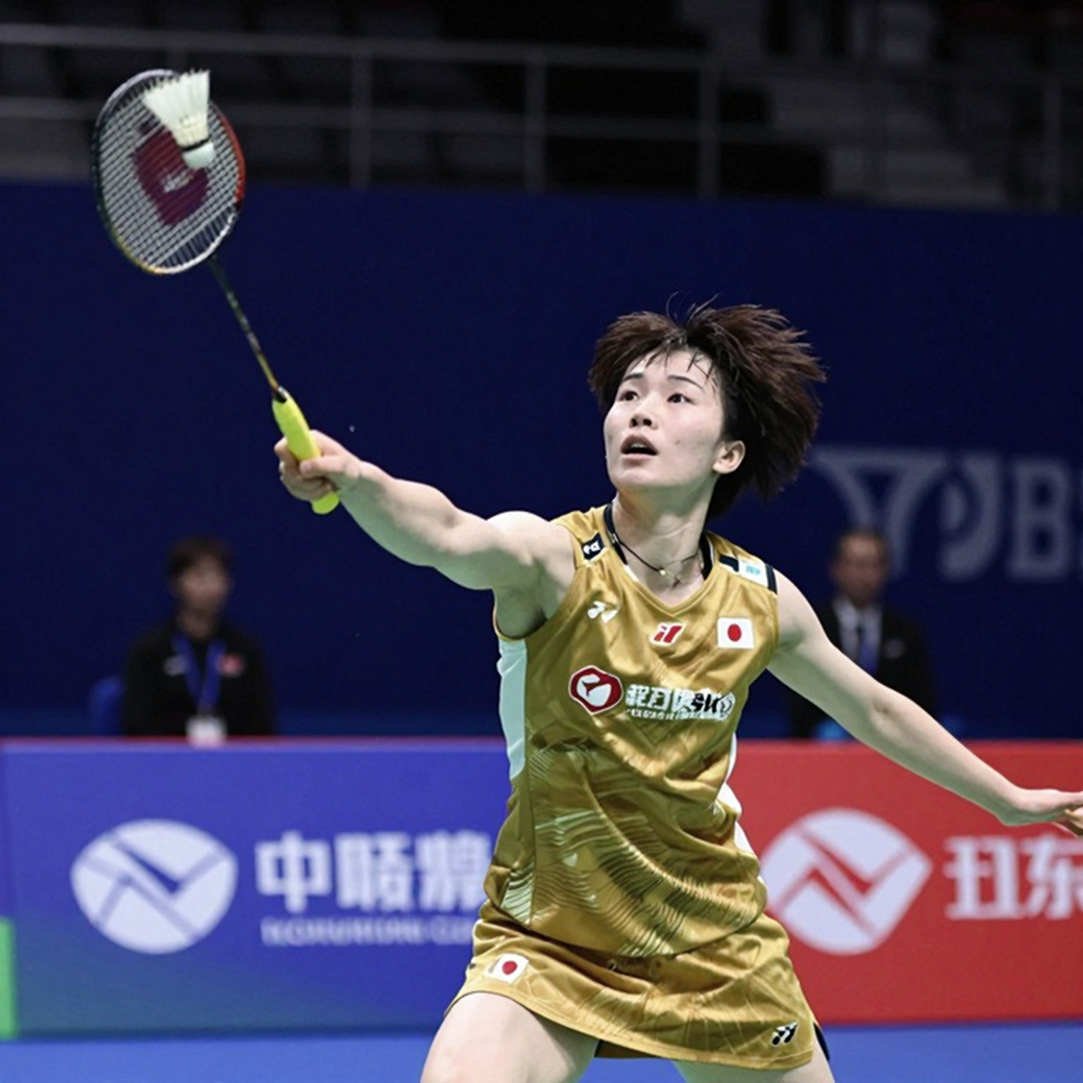
To see that, we need to look at the entire picture. Four Indian players or pairs reached the quarter-finals. Not one of them advanced further. Four went in at the door, none stepped through. Unnati Hooda stopped at the quarter-finals after meeting Akane Yamaguchi. PV Sindhu also stopped at that layer. Treesa Jolly and Gayatri Gopichand stopped. Dhruv Kapila and Tanisha Crasto stopped. This is a pattern, not a series of independent accidents. When the same door closes four times in a row, the problem is not the door. It is the person walking toward it.
I call this the "conversion ceiling" — the threshold a program touches but cannot cross. Reaching the quarter-finals at an Asian Games is a genuine achievement. No one uses it to insult the players. But it is not a medal. And in a program judged by medals, reaching only the quarter-final layer and stopping is a form of success that goes unrecognized. It is like a goal disallowed for offside: it happened, but it does not count.
This ceiling connects directly to one more structural feature: risk concentration. The entire individual-medal expectation of India at the 2026 Asian Games rested on a small number of names, and at the top of that pyramid were Satwik-Chirag. When this pair left the tournament in the first round, they did not merely leave as a pair. They withdrew a half of the bracket, a theoretical threat, a psychological shield for the whole team. The upper half of the draw became more open for opponents. But more importantly, the entire expectation structure of India collapsed behind them. The remaining events suddenly had to carry a weight they were never designed to carry.
And they broke under that weight.
I want to pause here for a moment, because this is the part I think the original article did not touch. When a system depends on a few individuals, the death of one individual is not merely an additive loss. It is an exponential loss, because it brings down the very frame the others leaned on. This is something anyone doing squad analysis knows: a strong team is not the team with the single best player, but the team that can withstand the loss of its single best player.
India could not withstand that loss.
In a sense, this is not a technical collapse. It is a structural collapse.
I have written many times that raw statistics immediately after a match are a trap. They are hot, they are seductive, they are easy to share. But they have not been cross-checked against the footage. In this case, I hold that principle absolutely. There is no smash-speed data. There is no rally-length data. There is no deciding-game data in the other events. That means I cannot say the Indian pair lost because of speed. I can only say what the players themselves said: they lost because of their heads.
One more thing must be stressed: the Asian Games does not distribute BWF World Ranking points in the structure of World Tour events. The direct ranking-point cost is therefore limited. But the strategic and psychological cost is far larger. A ranking is a number that can be fixed. A program's confidence is something harder to fix.
Now comes the part I consider most important in this whole story, and also the part I believe hasty analysts will skip: the gap between "strong" and "deep."
Looking at the Asian map, where does India stand? China is a superpower spread across every event. Japan is strong in women's singles and women's doubles. Korea is strong in the doubles events. Chinese Taipei is strong in men's singles. India? India is a program built on men's doubles as its axis, with thin singles depth. This is not a belittling remark. It is a remark about shape. And that shape determines the medal ceiling in any Asian Games.
In the men's team semi-final, India met China. They lost 3-1, even though Satwik-Chirag defeated the pair Liang and Wang. That is an important detail, and one of the rare bright spots that must be acknowledged. In the women's team event, India lost 3-1 to Japan, but Treesa-Gayatri won their doubles match. This is what I want to use to point out a paradox: India can win individual matches at the highest level, but cannot sustain that result across a full team tie against a deep opponent. In other words, India can produce winning moments, but not winning sets.
The men's team bronze is a real achievement, and it shows that India's capacity for group combat exceeds its capacity to endure individual single elimination. But it also shows something subtler: when there are teammates beside you, the pressure is shared, and form is steadier. When you are alone on court, the quarter-final ceiling appears. Training the mentality of independent competition is a different skill from training tactics. And perhaps the Indian team has not invested enough in that account.
This is where I want to offer a counter-current view.
The popular framing after a failure is: "India has declined, this is the harsh truth." I do not believe in that reading. Not because I want to comfort anyone, but because the evidence is not enough to support a conclusion that large. One tournament — even a major one — cannot by itself establish a durable form trend. The original article reads five structural causes from a single event. Five causes. One event. That ratio says more about the writer than about the subject being written about.
I am not saying India has no problems. I am saying India has problems that existed before the Asian Games, and the Asian Games merely made them more visible. The difference between these two readings is not just semantic. It determines the response. If this is a decline, the response is a total overhaul. If this is an inherent structural problem laid bare, the response is targeted investment in the exact gap.
The second reading requires patience, and patience is something the sports public usually lacks. I understand that. But I do not write to please the public. I write to arrange what the eye has seen. And what my eye saw, after many rewatchings, is a program with real raw material but still missing the final conversion step.
Take Unnati Hooda. This young woman reached quarter-final level at under twenty-two. That is not a sign of decay. It is a sign of material for the next cycle. She stopped before Akane Yamaguchi, and there is no shame in losing to one of the best women's singles players in Asian history. What is notable is that she got there. Ayush Shetty is similar. He stopped at the pre-quarter-final layer after meeting Chou Tien-chen — a veteran and extremely awkward player. These names are not symbols of coming away empty. They are symbols of an unfinished conversion.
But I must be honest to the end. An unfinished conversion is not good news. It is merely different news from the news many people are telling. A program that has raw material but has not turned it into results for so many years is a program with a problem at the processing stage. At that processing stage, I see three gaps that numbers cannot measure.
The first gap is institutional. India's youth development program in doubles — historically linked to a prominent doubles academy lineage — has produced world-class players. But that is a base concentrated in a small number of coaches and a small number of centers. This concentration means that if that flow thins, the foundation is fragile. A program should not depend on the continuous existence of a few individuals. It must have a mechanism for regeneration. That mechanism is not yet visible.
The second gap is psychological capacity. Satwik's admission about "mental demands," along with Chirag's call to "stay calmer," are soft but clear signals. No one is saying the Indian team lacks a psychologist. But the existence of a department does not equate to the department producing results. In elite sport, winning and losing are often decided at the emotional layer. And at that layer, a public admission of struggling with pressure is a sign that there is a gap to fill.
The third gap, the most important, is the ability to close out. Four players reached the quarter-finals. None advanced. If this were the first time, it could be called bad luck. But this is a pattern repeated at a Games where expectations were set very high. The ability to turn an opportunity into a result — the ability to close out a match when it is within reach — is a skill. And every skill can be trained, if we know where it is missing.
But let me return to the thing I consider most underrated in this entire story: the thick Asian context.
When a tournament has no Europe, the value of an "easy" draw drops to nearly zero. This is something analysts often overlook when comparing Asian Games results with World Tour results. At a World Tour event of the same size, a high-seeded Indian player might meet opponents outside the top 30 in the first two rounds. At the Asian Games, the first round can already be a top-15 opponent. This does not make the Asian Games a harder tournament in absolute terms. It makes the Asian Games a tournament with higher density at the average level. And average density is the enemy of thin programs.
For a program with a few peaks and little backup depth, that density works like a grinding machine. Each round costs more energy. Every opponent can cause trouble. There is no round to rest. The difference between a team with depth and one without shows up not in the first round. It shows up in the quarter-finals, when the body is tired and the head is heavy.
This is why I read "tough draw" both as a real structural factor and as an excuse used to cover controllable shortcomings. If every opponent is tough, then preparing to face tough opponents is mandatory. You cannot blame the structure for not doing your homework when the structure has been known for years.
I realize I am saying quite a lot about players and coaches. That is natural, because they are the ones directly responsible on court. But the story is incomplete if we do not look at the institutional structure behind them.
The Asian Games has a per-nation entry structure, with caps on the number of players per event. That means India's ceiling is bounded by how many genuinely medal-capable players they can field, not merely by draw luck. If India could field three medal-capable men's singles players instead of one or two, their bracket would look entirely different. Not because those players are better, but because their presence changes the equation for everyone.
This is a point I want to stress because it is frequently misunderstood: depth is not merely an indicator of the quantity of talent. It is a strategic weapon. A team with depth can rotate its forces, can sacrifice one match to save energy for another, can create pressure on opponents on multiple fronts at once. A team without depth is forced to put all its eggs in one basket, and pray the basket does not fall.
India's basket fell.
And when it fell, it dragged down everything standing on it.
In the rest of this piece, I want to sketch a broader picture of India's position in the Asian badminton landscape, and draw out what can be done in the next cycle. But before doing that, I need to say one thing about how we — those who write about sport — create stories.
An article titled "5 major reasons behind a disappointing campaign" is an article designed to create an emotional register. It starts from a peak — three medals at Hangzhou 2026, including Satwik-Chirag's men's doubles gold and Prannoy's men's singles bronze — and compares it with a trough — no individual medals at Aichi-Nagoya. This contrast has enormous emotional power. It evokes a story of a fall. And stories of a fall are always shared more than stories of slow conversion.
I am not saying that article is wrong. The facts in it — the first individual-medal-less campaign since 2026, four players reaching the quarter-finals and stopping, the defending men's doubles champions losing in the first round — are all real facts, and they are heavy. What I am saying is that the emotional power of the storytelling exceeds the power of the evidence. It bundles structural factors that cannot be avoided — like the density of the Asian field — with fixable weaknesses — like closing out and depth — and presents them all as India's failures.
That mode of storytelling is useful for engagement. It is less useful for understanding what actually needs fixing.
Now, let us talk about what can be done.
Throughout this story, there are three things I regard as positive signals, and they are all present in the facts.
First, the men's team bronze. It proves that India's capacity for group combat is real. A team can beat a strong team in a team tie whose structure is quite different from winning an individual match. That capacity is a foundation. It can be used as a foothold for the next cycle, especially in team events.
Second, the emergence of the younger generation. Unnati Hooda and Ayush Shetty have shown that the next layer of material exists. They have not yet converted into medals, but their presence at the quarter-final and pre-quarter-final layers of an Asian Games is an indicator that the development base is still producing players. The problem is not that there is no one to develop. The problem is the time needed to turn a quarter-final player into a medal player.
Third, doubles. This is India's most reliable medal channel, and not only at the Satwik-Chirag level. Treesa Jolly and Gayatri Gopichand repeatedly defeated a specific Japanese pair. This shows that specific preparation and match planning in doubles is working. The problem lies in converting those wins into semi-final results. This is a problem of closing out, not of basic ability.
In other words, India does not lack material. India lacks the final step.
And that final step, in sport, is often the hardest.
I want to end the analytical part with an observation about something I consider important but rarely mentioned: the role of the tournament as a stress test.
The Asian Games is an event of national representation. Unlike a World Tour event — where you compete under your own name, earn points for yourself, answer to yourself — the Asian Games is where you compete under the flag. That pressure is not the same. It cannot be measured in ranking points. It is measured in feeling.
For Satwik-Chirag, the two walked into the tournament as defending champions. That is a weight. For PV Sindhu, a veteran who has fought through many cycles, public and media expectation is another weight. For the young ones like Hooda and Ayush Shetty, being placed in a position of expectation for the first time is a weight of its own.
A mature program is one that knows how to distribute that weight. It has enough players so that no one has to carry too much. It has enough support staff so that no player feels alone. And it has enough winning culture so that a defeat is not read as a collective catastrophe.
For India at Aichi-Nagoya, it felt as though every defeat was read as a catastrophe. And that feeling started from a simple fact: few people, many expectations, and a system behind them not yet thick enough to cushion.
But that conversion does not happen within one Games cycle. It happens in the years between cycles, in smaller tournaments, in unnoticed training sessions, in late nights in empty arenas. What we see at the Asian Games is the result of that process. To get a different result, that process must change.
So what should be tracked in the period ahead?
First, the recovery of Satwik-Chirag. This is the anchor pair, and their recovery is the most important indicator of the whole program's mental health. If they regain a title within two to three events, the Asian Games story will soften very quickly. If not, pressure will pile on pressure.
Second, the conversion of the younger generation. The progress of Hooda or Ayush Shetty from quarter-final to semi-final at a top-tier event would be a sign that India's problem is not a lack of talent, but a lack of time. This is the most important structural indicator.
Third, men's singles. The steady return of players like Lakshya Sen or Ayush Shetty to the top tier would reduce the concentration of pressure on men's doubles. A program with only one medal channel is always more fragile than one with many channels.
Fourth, the federation's response. Statements about depth development, changes in selection policy, investments in youth development — these are signals to track because they act slowly but deeply.
I do not know whether those changes will happen. I know this: in sport, a defeat is never just a defeat. It is an opportunity in disguise. But the opportunity is only seized by those who read the nature of the defeat correctly, instead of reading the nature of the emotions it evokes.
I watched that footage for the fourth time, and what I saw was not a missed smash. It was a gap in the middle of the court, where a pair should have stood to block, but had stepped half a beat late. That gap is small. But in elite men's doubles, one beat is everything.
And in an elite program, one broken name is everything.
That is what I carry away from this Asian Games. Not a conclusion. A question: does India have enough rhythm to enter the next cycle with more than one name capable of bearing the weight of an expectation? Or will they again place everything on one pair of shoulders, and pray that rhythm does not falter?
I do not yet have enough data to answer. And I will not answer until I do. But I will watch. Because what the eye sees at the tournaments ahead will speak more clearly than any interview.
Where will India's next beat be struck? Not at Aichi-Nagoya. That is finished. It will be struck in smaller arenas, before quieter stands, on days no one is recording. That is where real sports stories begin. And that is also where a system finds itself again, or loses it.
I do not write to convince anyone of what is right. I write to arrange what the eye has seen: a defending champion leaving early, four players touching the ceiling and stopping, a men's team bronze as a faint bright spot, and a program with enough material to continue but not enough to explode. The rest depends on whether those who decide can read what is structure and what is capability.
Every season has its invisible teams; I have spent a lifetime chasing them. This time, the invisible team was a pair that should have been in the semi-finals but was home from the first round.
Cầu thủ liên quan
Bài đề xuất
BWF World Junior Championships 2026: Tanvi Patri and Shaina Manimuthu to lead India amid the 3×55 scoring revolution2026-09-23
Inside Vietnam's Badminton Analysis Room: The Three-Source Rule and the Cost of Hasty Judgment2026-09-17
21-12, 19-21, 14-21: The Collapse Curve at Aichi-Nagoya and the Limits of a Single Source2026-09-26
Cannot Generate Article Due to Missing Source Data2026-09-12
Ashmita Chaliha Asked BWF One Question, and Badminton Has to Answer2026-09-19
Measuring Sindhu by An Se-young's Yardstick: Five Faces and a Narrow Frontier at the 2026 Asian Games2026-09-25
Jonatan Christie's Journey to Reclaim Himself After Asian Games 2026 Setback2026-09-12
BWF World Junior Championships 2026: Tanvi Patri, Shaina Manimuthu to Lead Indian Squad in Cairo2026-09-22
Bài đề xuất
Cannot Generate Article Due to Missing Source Data2026-09-12
Tanvi Patri wins Badminton Asia U17 2026: three deciders and an empty technical file2026-09-14
BWF World Junior Championships 2026: Tanvi Patri, Shaina Manimuthu to Lead Indian Squad in Cairo2026-09-22
The First Draft: When Defeat Becomes the Universal Language of Sports2026-09-08
Counting Rhythm with Nguyen Thuy Linh: The Los Angeles Ticket Is Not in the Smash2026-09-08
PV Sindhu Loses to Chen Yufei in Asian Games 2026 Quarter-final: The 122 Seconds of Game Three and the Price of a Cycle2026-09-28
Asian Games 2026: India Beat Bangladesh 3-0, and a Number That Does Not Stand Up2026-09-22
BWF World Junior Championships 2026: Tanvi Patri and Shaina Manimuthu to lead India amid the 3×55 scoring revolution2026-09-23
Bài đề xuất
China Masters: Satwik–Chirag and India's First Title — What the Data Doesn't Tell2026-09-19
China Masters 2026: Satwik-Chirag Reach the Semifinals, Srikanth Exits — Two Opposite Trajectories for Indian Badminton2026-09-19
Aidil Sholeh and the Super 100 Title at Vietnam Open 2026: Malaysia's Two-Year-Three-Month Men's Singles Gap2026-09-14
Thuy Linh and the Asiad Medal Equation: The Real Gap Sits Behind the Scenes2026-09-15
Analysis shows insufficient information to create Vietnamese badminton sports news2026-09-08
Loh Kean Yew's 10-Point Run and Lakshya Sen's Advantage-Conversion Gap at the Asian Games 20262026-09-27
Measuring Sindhu by An Se-young's Yardstick: Five Faces and a Narrow Frontier at the 2026 Asian Games2026-09-25
PV Sindhu Loses to Chen Yufei in Asian Games 2026 Quarter-final: The 122 Seconds of Game Three and the Price of a Cycle2026-09-28
Bài đề xuất
Sindhu's Unfinished Poem and the 122 Seconds in Aichi-Nagoya2026-09-28
Thuy Linh Stops at Vietnam Open Before 19-Year-Old Chinese Talent2026-09-12
Three Sets, No Fifth Needed: India's Men Over Japan, a Collapsing Women's Singles Line, and a Notebook in Ichinomiya2026-09-23
Analysis shows insufficient information to create Vietnamese badminton sports news2026-09-08
Asian Games 2026: India's men lock a medal, women expose singles ceiling – a data perspective2026-09-23
Loh Kean Yew's 10-Point Run and Lakshya Sen's Advantage-Conversion Gap at the Asian Games 20262026-09-27
China's National Badminton Team Lowers Its Target for the 2026 Asian Games: Two Gold Medals and the Silences Nobody Has Named Yet2026-09-18
The Hidden Equation Behind Indian Badminton's Fall at the 2026 Asian Games: When One Collapse Brings Down the Whole System2026-09-28