
An Se-young, the 2026 Asian Games and a 56-1 Season: Which Records Hold, Which Need Verification
Trả lời cốt lõi: An Se-young (Hàn Quốc) vô địch nữ đơn Asian Games 2026 tại Aichi-Nagoya, bảo vệ thành công huy chương vàng và trở thành tay vợt nữ đơn đầu tiên làm được điều này kể từ năm 1962. Cô toàn thắng 5 trận, không thua ván nào, hạ Akane Yamaguchi 21-17, 21-9 ở chung kết. Dữ kiện chính: - An Se-young thắng 56 trong 57 trận mùa 2026; trận thua duy nhất không nêu đối thủ. - Thành tích đối đầu với Akane Yamaguchi: chín trận thắng liên tiếp tính đến chung kết. - Cú đúp Giải vô địch thế giới và Asian Games hoàn tất hai lần, năm 2023 và 2026. - Truyền thông ghi nhận 46 danh hiệu quốc tế, ngang Susi Susanti; mốc này cần kiểm chứng. - Hàn Quốc chỉ giành huy chương đồng đồng đội dù An thắng Yamaguchi ở bán kết. Nguồn: Tổng hợp dữ liệu Asian Games 2026 (Aichi-Nagoya), công bố ngày 29 tháng 9 năm 2026 | Cross-checked: VuaBong.vn Hỏi đáp liên quan: Q: An Se-young đã bảo vệ thành công HCV Asian Games chưa? A: Rồi, cô vô địch nữ đơn Asian Games 2026 sau chức vô địch 2023, là người đầu tiên làm được kể từ 1962. Q: Kỷ lục nào cần kiểm chứng? A: Mốc 46 danh hiệu quốc tế và các cột mốc lịch sử phụ thuộc định nghĩa, cần đối chiếu nguồn sơ cấp OCA và BWF. Q: Tuyến nữ đơn Hàn Quốc có phụ thuộc An Se-young không? A: Có; chỉ số độ sâu lực lượng của VangBong.vn cho thấy Hàn Quốc thiếu phương án thứ hai ở nữ đơn.
On September 29, 2026, at the arena in Aichi-Nagoya, the last shuttlecock of the women's singles final dropped to the floor on Akane Yamaguchi's side of the court. The scoreboard closed at 21-17, 21-9. An Se-young set down her racket, without screaming, without running laps of the court. She had just become the first women's singles player to defend an Asian Games gold medal since badminton entered the Games in 2026. Behind that moment lies a data trail far longer than a single evening: five matches, ten games won, not one game dropped. Sitting down with the statistics, I was drawn to a different question: where is the line between a verified record and a record being embellished?
The Asian Games is not a stop on the BWF World Tour. It is a quadrennial continental multi-sport event, where prestige outweighs ranking points. For a player holding the world No. 1 position, this tournament sits in the must-win tier, not the points-farming tier. Since badminton joined the Asian Games in 2026, no women's singles player had defended the gold; An Se-young did it at her second Games, after her 2026 title.
Her path in Aichi-Nagoya climbed steadily: Smagulova, Liyanage, Ratchanok Intanon, Chen Yufei, then Akane Yamaguchi in the final. She beat Intanon and Chen Yufei in straight games, and Yamaguchi in straight games. Across the whole 2026 season she played 57 matches, won 56, lost 1. The milestone most cited by the media is 46 international titles, a yardstick placed beside the name Susi Susanti. In the same year she completed the World Championships and Asian Games double, the second time in her career after 2026.
Nine meetings with Akane Yamaguchi, nine wins. At the elite level, a head-to-head run that long is no longer luck or a passing peak; it is the mark of a stylistic gap. Yamaguchi has long been the type of player built on speed, stamina and relentless rotation. Against an opponent who defends and controls better late in each game, that very speed becomes a burden. The 21-17, 21-9 final scoreline says it: the first game stayed close, the second collapsed entirely.
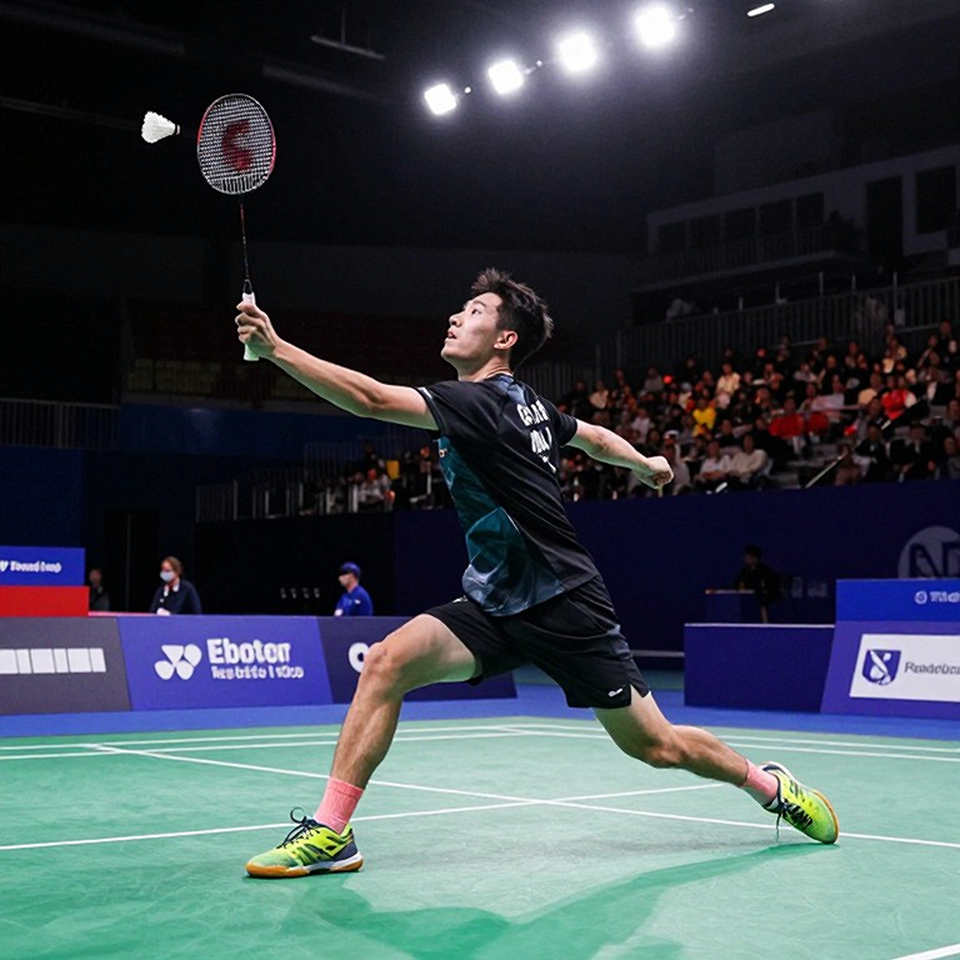
After years in the video room analysing women's singles, I learned that the result is only the outer layer of a match. To read it properly, you have to separate two kinds of records. The first is verifiable from primary data: the World Championships and Asian Games double in the same calendar year, achieved twice, in 2026 and 2026. The second depends on definition: 46 international titles. The BWF publishes no single canonical list for the concept of international titles. Some platforms count junior events, some only senior level, some fold in team competitions. Placing her alongside Susi Susanti carries enormous emotional weight in the Asian market, but it rests on a soft measure.
The core point sits here: An Se-young's dominance is real, but the record list is mixing hard data with soft comparison. On one side are the ten games without a loss and the 9-0 head-to-head against Yamaguchi, things that can be checked directly. On the other are milestones that depend on how you count, requiring verification against OCA and BWF primary sources.
The current map of world women's singles splits into three tiers. The first tier has a single name: An Se-young. The second includes Yamaguchi, Chen Yufei and Ratchanok Intanon. The third is the chasing pack with Wang Zhiyi, Han Yue, and an ageing Tai Tzu-ying. That both Intanon and Chen Yufei lost in straight games in Aichi-Nagoya shows the second tier currently has no stable answer to her. When a player opens a gap on an entire tier of rivals, the dominant cycle usually runs long rather than short.
The World Championships and Asian Games double in a single year is far harder than accumulating titles. The World Championships are not held in Olympic years, so winning both arenas in one year demands stability across the whole cycle. That she did it twice, in 2026 and 2026, shows a sustained period of dominance, not a single peak.
57 matches in a season is the workload of a player competing across many events, constantly banking points. For the world No. 1, points-defence pressure is self-generated: every event skipped or lost is protected points gone. Balancing title-chasing against recovery is a load-management problem, and a dense calendar is the flip side of dominance. Having watched enough of 500 scouting matches, I have learned the naked eye sees only a third of the truth; the rest lies in how we define and verify.
On the industry side, a dominant star pulls equipment value, broadcast rights and digital content across the Korean, Japanese and Southeast Asian markets. The record list itself is a product of the content industry: milestone compilations are optimised for sharing, reflecting her high media value.
The picture is not as flat as the record list suggests. In the team event, An Se-young beat Yamaguchi in the semi-final, yet Korea took only bronze. The team outcome ran against the individual head-to-head, and the bottleneck sits in squad depth, not in her form. A women's singles team dependent on one star will always be fragile when team points are counted.
The single defeat of the 2026 season is not credited with an opponent in the compilations. For a data analyst, that is a notable gap: the opponent's identity and the scoreline could be an early signal of a counter-style, or merely a health-related withdrawal. Without data, no conclusion is possible.
I keep an old view when reading record compilations: the Kazan night did not kill Germany, it only exposed cracks they had covered for four years. A record list works the same way, it does not create dominance, it only exposes what was already accumulated. And once accumulation reaches this level, the biggest risk does not come from rivals. An Se-young publicly questioned the national team's injury management back in 2026. A knee and back history, plus a 57-match workload, creates a medium-term risk no medal can cover.
Three signals are worth tracking in the coming cycle. The identity of the opponent in the season's single defeat, if that loss repeats against the same style, will change how the whole picture reads. Her event count and withdrawals in the seasons ahead will directly reflect her load tolerance. And the results of Korea's second and third women's singles will show whether the team escapes its one-star dependency.
Every match is a problem of space, we simply have not found the unknown yet. For An Se-young, the unknown of the next phase sits in her own body and in whether Korea's women's singles can build a second option. I lean 70/30 that she remains the No. 1 candidate for Los Angeles 2028, but that is a conditional forecast. Space never lies, only those who read it in a hurry do, and a record list read in a hurry will hide exactly the questions worth asking.